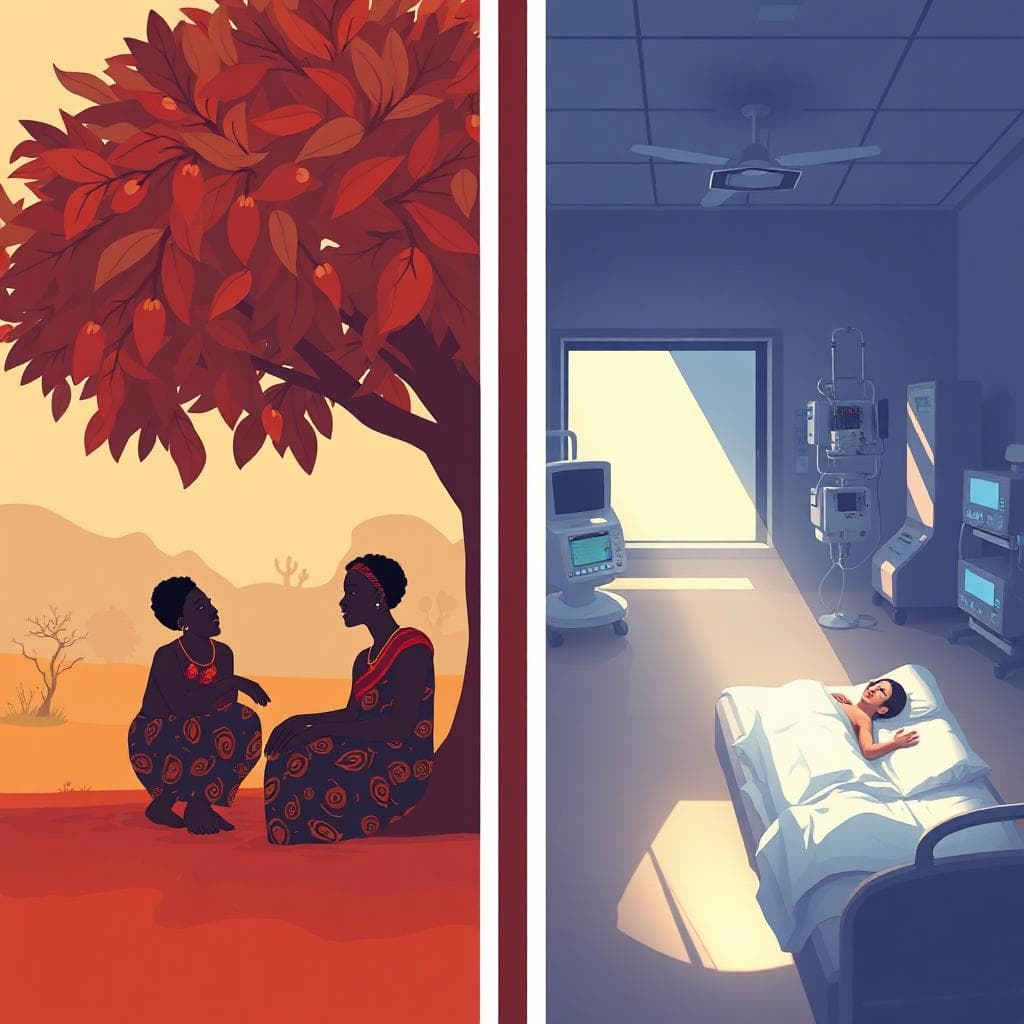
The Untold Story of Childbirth in Africa
Under a mango tree in a West African village in 1933, a woman named Amina labored surrounded by her sisters. She rocked, squatted, clung to a rope tied to a beam, and breathed with the rhythm of the women who sang soft, familiar songs. A midwife—older, experienced, unhurried—guided her hands, massaged her back, and placed warm leaves on her belly. The baby slipped into the world with the help of gravity and community. No machines hummed. No fluorescent lights glared. Just breath, touch, and knowledge passed down through generations. Jump now to 1995 in Accra, where a young mother is wheeled into a hospital. Monitors beeping, an IV drip, a nurse adjusts her legs into stirrups while the doctor explains options. The room smells of antiseptic. She is offered an epidural. The world she moves through now is clinical, controlled, and—if statistics are to be believed—safer in many measurable ways. These two scenes—traditional and modern—aren’t merely different settings; they are different philosophies of birth. The story of how African women gave birth and how modern medicine came to dominate that story is layered with practicality, culture, and politics. The positions women used Across Africa, for centuries and still today in many places, women gave birth in ways that felt right to their bodies and communities. Common positions included: - Squatting: Widely used across West, East, and Southern Africa. Squatting opens the pelvis and uses gravity to aid descent. - Kneeling or semi-sitting: A halfway posture, giving support while allowing pelvic opening. - Hands-and-knees (all-fours): Used to relieve back pain and shift fetal position. - Standing or walking during early labor: To encourage progress and comfort. These positions were accompanied by a social system. With elder midwives, birthing attendants, supportive songs, and herbal compresses, that calmed and empowered the laboring woman. Birth was communal, embodied, and adaptive.
WHEN AND WHY THE WESTERN, SUPINE MODEL ARRIVED
The Western medical model—where a woman lies on her back (the lithotomy or supine position)—became dominant in hospitals globally and in many parts of Africa during the 19th and 20th centuries.
IMPORTANT HISTORICAL WAYPOINTS: - 17th–18th centuries: European obstetricians began developing instruments like forceps (early versions used secretly by the Chamberlen family in the 1600s, publicized later), shifting some births from midwife hands to physician-led deliveries. - Mid-1800s: The rise of hospital births in Europe and North America. Ignaz Semmelweis in 1847 identified handwashing as key to reducing puerperal fever—an early medical advance showing how hospital practices could reduce death. - Late 19th–20th centuries: Colonial expansion (late 1800s–mid 1900s) brought Western hospitals and training to Africa. Colonial health systems often favored clinical, doctor-led care. - 20th century medical advances: The development of safe anesthesia, blood transfusion techniques, antibiotics (penicillin popularized in the 1940s), oxytocin for labor management, and safer surgical techniques pushed hospitals to the foreground. - Post-1945: International health bodies and aid programs promoted hospital-based maternal care as a way to reduce high maternal and infant mortality. Global campaigns in the late 20th and early 21st centuries emphasized facility births; maternal mortality ratio declines in many countries followed (though unevenly).
EXPLORING THE PROS AND CONS OF BOTH APPROACHES —TRADITIONAL POSITIONS VS. MODERN HOSPITAL APPROACH Traditional birthing positions (squatting, kneeling, hands-and-knees)
PROS:
Gravity-friendly: Squatting and similar positions can shorten pushing and make use of pelvic mechanics.
Agency and mobility: Women could move, find comfort, and participate actively. - Community support: Emotional, social, and practical help from experienced women. - Low intervention: Less routine use of episiotomy, forceps, or C-section simply because the posture and protocols encouraged spontaneous progress.
CONS:
Limited emergency interventions: In cases of prolonged labor, severe bleeding, obstructed labor, or fetal distress, remote communities without rapid transfer to surgical care faced higher risks. - Infection and lack of sterile supplies: Before antibiotics and sterile techniques, postpartum infections could be deadly.
Unequal outcomes: Where trained midwives and referral systems existed, outcomes could be good; where they did not, maternal and neonatal mortality were higher. Modern hospital-based supine births and medical intervention
PROS:
Emergency capability: Access to Caesarean section, blood transfusion, antibiotics, and neonatal resuscitation can save lives in complications. - Monitoring: Fetal heart rate monitoring and clinical assessment can detect distress and prompt timely action. - Pain relief and controlled environment: Epidurals, controlled induction, and surgical options offer choices and rescue strategies
CONS:
Positioning issues: Lying supine works against gravity, may narrow pelvic outlet, and can increase duration or need for assisted delivery for some women. - Overmedicalization: Routine interventions—induction, continuous fetal monitoring, episiotomy, or C-section—can be overused in some settings, exposing women to unnecessary risks.
Loss of agency and intimacy: Clinical protocols and sterility can make birth feel impersonal; women may be moved into positions they didn’t choose. - Access and inequality: Hospitals are concentrated in cities; rural women may still lack access, and even in urban areas, quality varies
WHY MODERN MEDICINE TOOK PRECEDENCE The ascendancy of hospital-based obstetrics is not just about technology—it’s about safety narratives, politics, and infrastructure. - Measurable reductions in mortality: The hard truth that antibiotics, blood transfusions, safe C-sections, and trained surgeons reduce deaths pushed public health systems to favor hospitals. Between 1990 and 2015, global initiatives helped reduce maternal mortality worldwide, and facility-based care was a big part of that push. - Colonial legacies and training: Colonial administrations set up Western-style clinics and trained local staff in European methods. Over time, local medical education and professional prestige reinforced hospital norms. - Legal and liability frameworks: Doctors trained in hospital settings are expected to follow protocols—positions that allow rapid intervention are preferred because they enable quick surgical access, use of forceps, or episiotomy when needed. - Urbanization and convenience: As populations moved to cities, hospitals became more accessible and were perceived as safer—especially when dramatic stories of obstetric emergencies circulated. - Global health agendas: From mid-20th century onward, donor-funded projects and WHO guidelines emphasized facility births and skilled attendance as key indicators of progress. FINDING BALANCE: A MIDDLE WAY Today you can hear midwives, obstetricians, policymakers, and women themselves talking about hybrid models. In the 21st century, many clinics and hospitals in Africa are experimenting with more woman-centered care: allowing upright positions, supporting doulas or family attendants, encouraging mobility during labor, and integrating skilled midwives who respect cultural practices while keeping emergency backup ready. Countries with strong midwifery systems and clear referral networks—examples being parts of Rwanda and Ethiopia in recent decades—show improved outcomes when tradition and modern safety nets are combined. A HUMAN TRUTH The story of how African women gave birth is not a straight line from superstition to science. It’s a braided rope of knowledge, faith, necessity, and innovation. The squat and the operating theatre both have virtues and limits. For many women today, the ideal is agency plus safety: the right to birth how they feel best, backed by a system that can handle emergencies when they arise. Remember Amina under the mango tree and the young mother in Accra. What matters most isn't declaring one approach superior forever; it's making sure every mother has the choice, the support, and the safety she needs—whether that means a cord tied to an elder’s wisdom or the steady hands of a surgeon in an emergency. Birth is stubbornly human. It adapts, survives, and teaches us that progress must carry culture, comfort, and compassion along with it.