Back to Articles
Damilola Adeyinka
A Paradigm Shift In African Work Culture
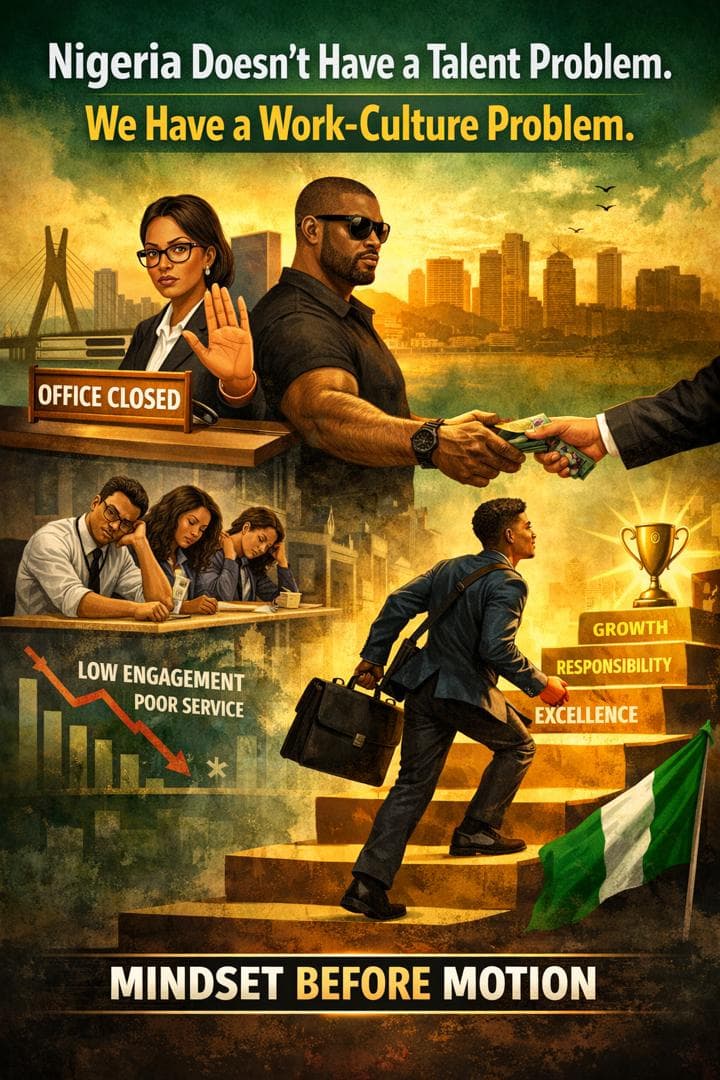
Nigeria Doesn’t Have a Talent Problem. We Have a Work-Culture Problem.
Nigeria is not short of brilliance. From tech innovators building globally competitive products, to creatives dominating international stages, to entrepreneurs bootstrapping ideas into profitable ventures — talent is not our national deficit.
Our deeper issue is work culture.
The employee culture in Nigeria has been plagued by a mindset that stalls professional growth and quietly spills into other areas of life. Because the truth is simple:
How you do anything is usually how you do everything.
When work is treated casually, defensively, or opportunistically, the consequences don’t stop at the office door. They shape character, relationships, and long-term relevance.
This is not an insult. It is a diagnosis.
THE SERVICE GAP
The average Nigerian employee often has an abysmal understanding of service and the true idea of work.
Take this familiar example.
The average secretary — whether to a university dean or a multinational CEO — sometimes sees the role as a tool of control instead of service. They turn access to currency and use delays to flex power. Gatekeeping becomes ego protection.
“Me sef no small for this life.”
So the job subtly shifts from enabling flow, access, and excellence to lording over people perceived as threats to their fragile egos.
Or consider the average bouncer at an event. The role is meant to protect the guest experience. Yet too often, it becomes an opportunity to “tax” rich-looking attendees rather than safeguard the environment they were hired to serve.
This mindset is not isolated. It is systemic.
And while this case study is Nigeria, poor work culture is not exclusively Nigerian or even African. It is a global issue. However, in many parts of Africa, the need for urgent intervention is glaring.
THE GLOBAL CONTEXT: ENGAGEMENT IS LOW EVERYWHERE
According to a Gallup Workplace Report, only about 15–20% of employees globally are actively engaged at work. Engagement levels in Sub-Saharan Africa rank among the lowest worldwide.
Low engagement strongly correlates with:
* Poor service delivery
* Weak ownership mentality
* Ethical lapses
* Low productivity
Similarly, a PwC Africa Workforce Survey shows that a significant percentage of employees see their jobs merely as a means to an end — not as a platform for mastery, growth, or long-term relevance.
When work is just survival, excellence becomes optional.
THE LABEL PROBLEM
This partly explains why the average Nigerian employee is often labeled — fairly or unfairly — as:
* Selfish
* Lazy
* Opportunistically dishonest
Not because Nigerians are inherently bad workers.
But because many were never taught that:
* Work is service, not power.
* Position is responsibility, not leverage.
* Ownership mentality is not doing your boss a favor — it is a proven career growth hack.
We trained people to get jobs.
We did not train them to build careers.
OWNERSHIP MENTALITY: THE CAREER MULTIPLIER
Ironically, research consistently shows that employees who adopt an ownership mindset:
* Grow faster in their careers
* Earn more over time
* Build stronger professional reputations
* Become indispensable rather than replaceable
Ownership mentality doesn’t help your boss first.
It helps you.
It sharpens your work ethic.
It compounds your competence.
It builds trust equity.
And most importantly, it travels with you from job to job.
Titles can be taken away.
Companies can fold.
But competence compounded over time becomes portable power.
MINDSET BEFORE MOTION
We often look for external solutions:
* Salary increases
* Policy reforms
* Performance incentives
* Motivational speeches
Yet until we fix how we think about work, none of these will create sustainable transformation.
Work culture is not about slogans on office walls.
It is about mindset before motion.
It is about understanding that the smallest role, executed with excellence, becomes a training ground for leadership.
It is about recognizing that service is not subservience — it is strategy.
It is about realizing that professionalism is not colonial; it is universal.
THE CONVERSATION IS LONG OVERDUE
Nigeria does not need more talent pipelines alone.
We need a cultural reset around work.
We need to teach service as strength.
We need to redefine ownership as self-interest properly understood.
We need to stop seeing jobs as temporary survival tools and start seeing them as arenas for mastery.
Because until we fix how we think about work, we will keep exporting talent while underperforming at home.
And the tragedy is not lack of capacity.
It is misdirected mindset.
That conversation is long overdue.